 Traction Outsourcing
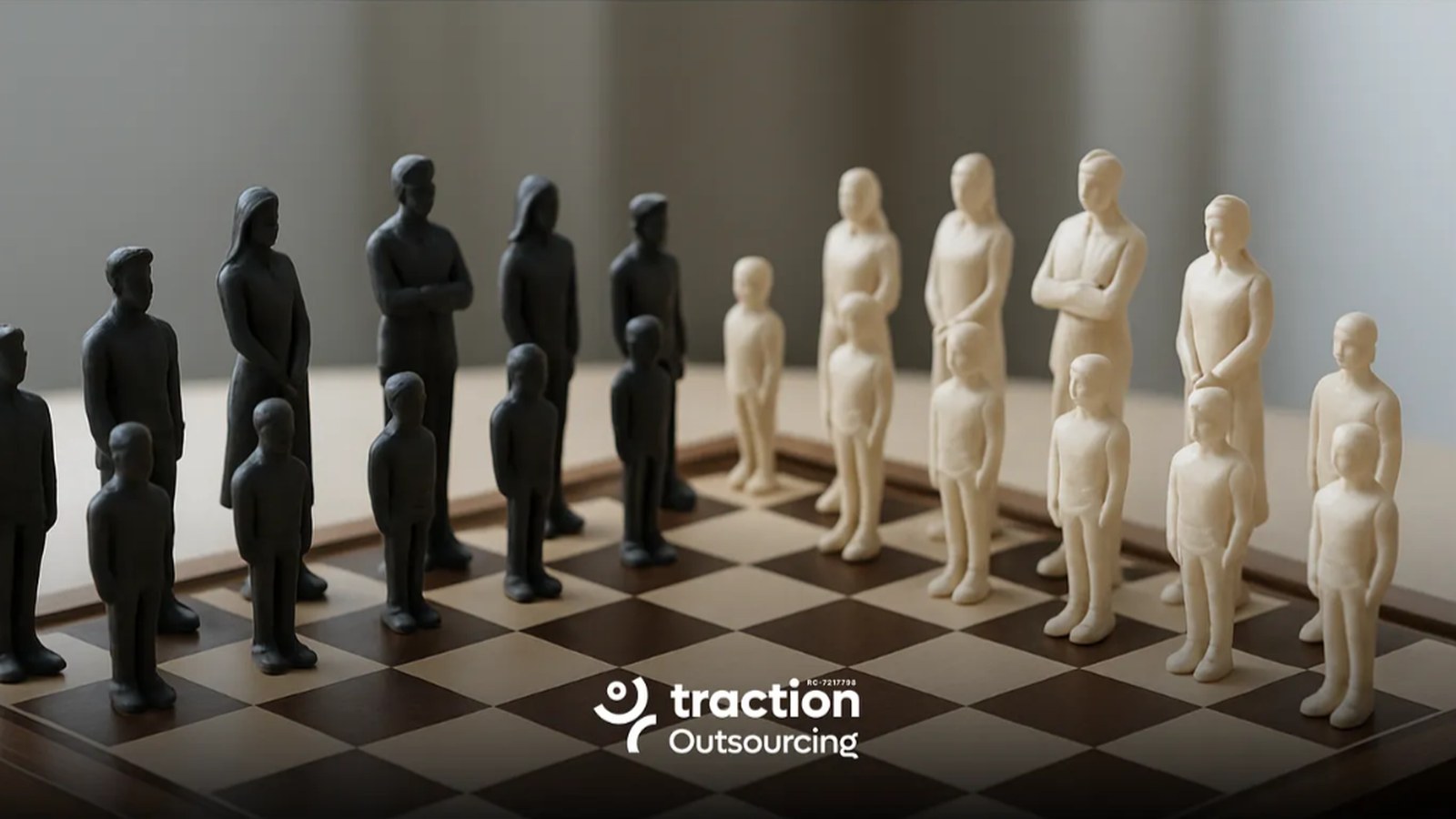
Many of us grew up watching a chess board without knowing that its modern design, the one Nathaniel Cooke and Howard Staunton popularized generations ago, was ever a deliberate choice. Yet once you understand the logic behind each move, the whole game changes. A business works the same way. What looks like a random arrangement of departments and job titles is often a structure built, or left unbuilt, on purpose. That structure is called organizational design, and it determines whether a company can adapt when conditions change.
What Organizational Design Actually Means
Organizational design is not just a chart pinned on a wall. It is the framework that shows how people, roles, and tasks connect to deliver on strategy. It tells you who owns what decision, how information moves, and where accountability sits.
What This Looks Like in Practice
Consider two examples from the corporate world. A large consumer goods multinational reorganized itself into a handful of core business groups. The result was clearer accountability and faster response to market shifts. Around the same time, a global technology company shifted its focus away from hardware and rebuilt its teams around software and services. Neither company changed its ambition. Both changed how work was organized to support that ambition.
Why Most Restructuring Efforts Fail
Despite how important this is, most companies get it wrong. Research suggests that a large majority of organizations, well above half, still run on structures that are outdated or unclear. Only a small fraction have models that are genuinely flexible enough to respond to change. This gap explains why so many restructuring efforts fail to deliver what they promised. When leadership changes reporting lines without first fixing the underlying design, the business simply carries its old problems into a new shape.
Good organizational design is not about redrawing boxes on a page. It is about reshaping how the company actually works day to day. Picture the chess board again. Every strong opening move protects the pieces that matter most while creating room to grow. A company that gets its design right keeps its core identity intact while improving how decisions are made and how work flows between teams.
Why This Matters for African Businesses
Businesses across Africa are not exempt from this reality. As companies expand into new states, new countries, or new product lines, the structures that worked at a smaller scale start to strain. Family-run conglomerates transitioning to professional management, banks integrating after a merger, and fast-growing startups scaling their operations all face the same question: does our current structure still serve our strategy?
When to Revisit Your Organizational Design
There are clear moments when a business needs to revisit its organizational design. Expansion into new markets, mergers and acquisitions, leadership transitions, and sustained performance problems are the most common triggers. In each case, the symptoms show up as confusion over roles, slow decisions, or duplicated effort, but the root cause is almost always structural.
Our Eight-Step Organizational Design Model
At Traction Outsourcing Limited, we approach this through an eight step model that treats organizational design as a living process rather than a one time event.
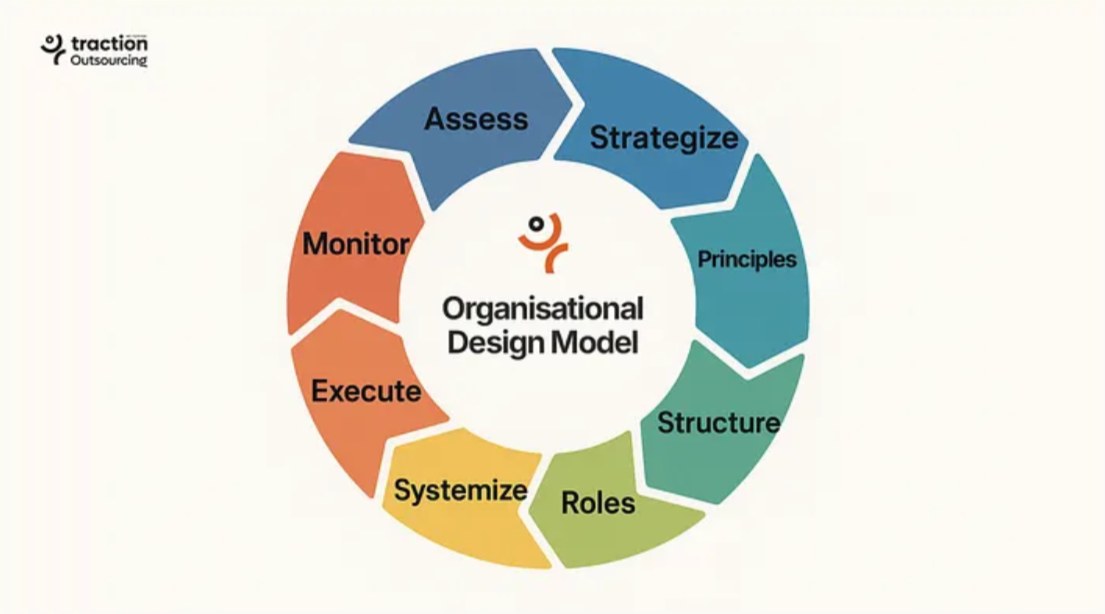
- Assess. We begin by assessing the current state honestly, understanding what is and is not working before changing anything.
- Strategize. Design choices are aligned to where the business is actually going, not just where it has been.
- Principles. We set the guiding principles that will shape every structural decision that follows.
- Structure. The structure itself gets built: reporting lines, groupings, and how work actually flows between teams.
- Roles. Roles are defined clearly, so ownership and accountability are never ambiguous.
- Systemize. Systems are put in place to support the new design, rather than leaving it to informal habit.
- Execute. The new design is executed with discipline, not left half-implemented.
- Monitor. Results are monitored so the design keeps evolving as the business does.
A company does not need a perfect structure. It needs one that matches where the business is going, not where it used to be. Getting this right early saves the cost, confusion, and lost momentum that come from restructuring without a plan.
Further Reading: What Is Business Restructuring?, How to Create an Organogram for Your Nigerian Business, Corporate Restructuring.
Is Your Structure Still Serving Your Strategy?
Book a free 30-minute advisory call. We will review your current structure and tell you honestly whether a redesign is what your business needs.